Your cart is currently empty!
Mushroom Chocolate Bars (Canada): Cacao, Craft, and What the Science Says
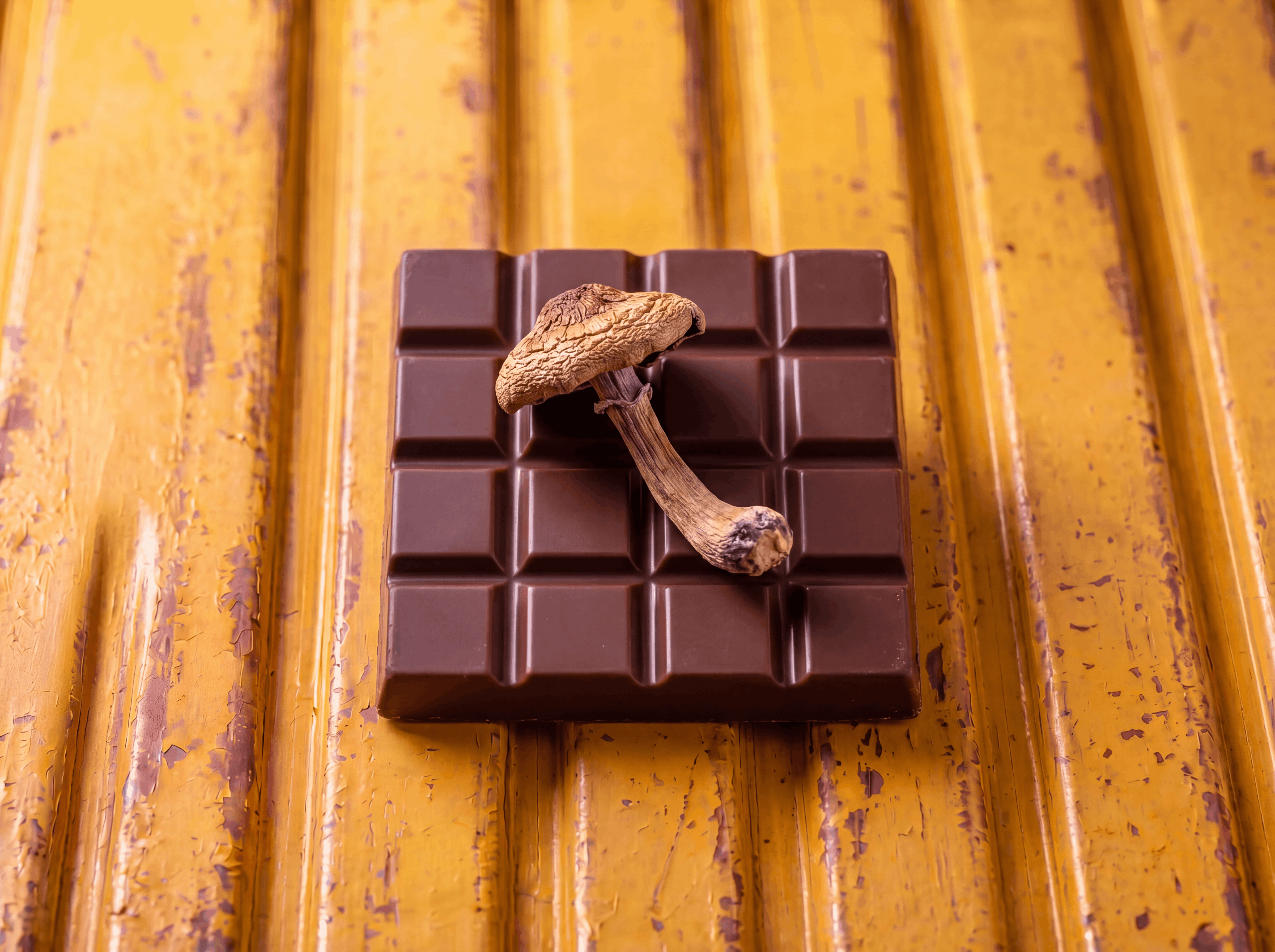
Mushroom chocolate has become one of the most talked-about products in the psychedelic conversation — and one of the most misunderstood. Most coverage focuses on the mushrooms and treats the chocolate as a delivery vehicle, little more than a wrapper.
That misses something interesting. Cacao has its own long history, its own chemistry, and a genuinely ancient relationship with mushrooms. And the way chocolate is actually made turns out to matter enormously — it’s the single biggest reason mushroom chocolate is so unpredictable.
This article covers both halves honestly: where the pairing comes from, what’s really in cacao, how chocolate is made bean-to-bar, why dosing in these products can be unreliable, and what the research does and doesn’t show.
A Pairing With Deep Roots
The pairing of cacao and mushrooms is not a modern marketing invention. It’s centuries old.
Cacao’s botanical name, *Theobroma cacao*, translates as “food of the gods” — a clue to how seriously Mesoamerican cultures took it. Cacao was a sacred plant, used as a spiritual offering and consumed before significant decisions. It was currency, ritual, and medicine long before it was a candy bar.
And it was frequently paired with mushrooms. As Soul Lift Cacao documents, the Aztecs combined *teonanácatl* — literally “flesh of the gods,” their name for psilocybin mushrooms — with cacao, serving the two together as a mixed beverage in ceremony. Two “gods’ foods,” taken as one.
So when a modern chocolate bar puts mushrooms and cacao together, it’s echoing something with real historical depth — even if the packaging rarely mentions it.
What’s Actually in Cacao?
Cacao is chemically busy. Unrefined, it contains well over a hundred distinct compounds. A few get most of the attention.
Theobromine is the main event. A close cousin of caffeine, it’s a vasodilator — it widens blood vessels and increases blood flow. The result is a lift that most people describe as calmer and more grounded than a coffee jolt: alert, but not jittery. This is the compound most responsible for how cacao actually makes you feel.
Phenylethylamine (PEA) and anandamide get breathless treatment in wellness marketing — the “love chemical” and the “bliss molecule.” Here’s the honest version: research indicates both occur in cacao in quantities too small to produce meaningful psychoactive effects. It’s a lovely story, but the chemistry doesn’t support it, and you’ll see it repeated uncritically almost everywhere. Treat those claims with scepticism.
Why Cacao and Mushrooms Pair So Well
Beyond history, there are three practical reasons the combination persists.
Flavour. This is the big one. Psilocybin mushrooms taste unpleasant — earthy, bitter, and unmistakably fungal, and many people find the texture worse than the taste. Dark chocolate is intensely bitter and aromatic in its own right, which makes it uniquely good at burying that flavour. Very few foods can hide mushrooms; chocolate can.
Fat. Cocoa butter is a fat-rich medium, which makes it an effective carrier for powdered material and gives the finished product a texture that’s easy to eat.
Chemistry — with a caveat. Cacao contains small quantities of monoamine oxidase inhibitors (MAOIs), and it’s often claimed these slow the breakdown of psychoactive compounds and therefore amplify or prolong effects. This is the most commonly cited biochemical rationale for the pairing. It’s worth being careful here: the amounts involved are small, and the evidence for a meaningful interaction is thin. It may be a modest effect, or largely folklore. Anyone treating it as a reliable amplifier is going beyond what the science supports.
-
 15% Off &
2x PointsMELT-PROOF 🧊Haven – Mushroom Gummies$32.00 – $46.00$27.20 – $39.10 -
 15% Off &
2x PointsWonder – Mushroom Gummies (3000mg)$25.00$21.25 -
 15% Off &
2x PointsWonder – Mushroom Chocolate Bar (1000mg)$9.97$8.47
How Chocolate Is Made: Bean to Bar
To understand why mushroom chocolate is so inconsistent, you first need to understand how chocolate itself is made. It’s a longer process than most people realise.
Fermentation and drying. Cacao beans are removed from the pod and fermented — a step that develops the precursors of chocolate flavour — then dried.
Roasting. Heat develops aroma and deepens flavour, much like coffee.
Cracking and winnowing. The brittle outer shells are cracked off and blown away, leaving cacao nibs.
Grinding. The nibs are ground until they liquefy into chocolate liquor (no alcohol involved — just cocoa solids suspended in cocoa butter).
Conching. The chocolate mass is continuously mixed, ground, and aerated — sometimes for hours, sometimes for days. This refines the particle size, smooths the texture, and lets harsh volatile acids evaporate. Conching is the difference between gritty and silky. This is where you would combine pulverized psilocybin (golden teacher is a gentle favourite). Precise dosing is key here for a more predictable experience.
Tempering. This is the craft step. Chocolate is carefully heated, cooled, and reheated within precise temperature windows to encourage cocoa butter to form the right kind of crystal. Get it right and you get gloss, a clean snap, and a bar that doesn’t melt on contact. Get it wrong and you get dull, soft, streaky chocolate.
Moulding. The tempered chocolate is poured into moulds, tapped to release air bubbles, and cooled until solid.
How Mushroom Chocolates Are Made — and Why Dosing Can Be Unreliable
Here’s the part that matters most, and the part almost nobody explains.
Mushroom chocolate is typically made by blending dried, powdered mushrooms into chocolate during or after tempering, then moulding it into a segmented bar. Simple enough in principle. In practice, it introduces challenges.
Psilocybin content varies naturally. Even within a single flush of mushrooms, potency differs from cap to cap and stem to stem. That variability is inherited by anything made from them. Potency testing is key. When a manufacture utilizes potency testing in their process, they will vary the amount of actually mushroom volume based on the potency level so that the psychedelic experience is consistent.
Powder doesn’t distribute evenly. Properly homogenising a solid into viscous chocolate requires industrial mixing equipment. Without it — and most small producers don’t have it — the powder clumps. The result is what’s often called “hot spots” — one square of a bar can contain a wildly disproportionate share of the active compound while the square beside it contains almost none.
For someone new, or someone with low tolerance, that’s not a minor inconvenience — it’s the difference between a mild experience and an overwhelming one. A well made mushroom chocolate bar uses industrial equipment that guarantees properly blended ingredients.
Onset and Duration
Effects from mushroom chocolate typically begin 30 to 60 minutes after eating, and peak around 90 to 120 minutes.
Be mindful, like with any edibles to not get caught in the redosing trap. Chocolate is rich in fat and sugar, which slow gastric emptying — meaning onset can be delayed further and the overall experience stretched longer than expected.
This sets up the single most common mistake people make: eating more because “it isn’t working.” Someone takes a square, feels nothing after 45 minutes, takes another — and then both doses arrive together at full strength. Edibles of every kind create this trap. Patience is the entire safety strategy.
Safety, Set and Setting, and Who Should Avoid It
Some people should not take psilocybin at all.
Personal or family history of psychosis, schizophrenia, or bipolar disorder is the most important contraindication.
Beyond that, the classic guidance about set and setting holds: mindset and environment shape the experience profoundly.
What the Microdosing Research Actually Shows
Microdosing — taking sub-perceptual amounts — is where a lot of the current enthusiasm lives. The honest summary is that the evidence is mixed.
Some clinical work suggests modest improvements in mood and cognition. Other well-designed studies find no significant difference from placebo, and placebo effects in this area appear to be substantial — unsurprising, given that people who microdose usually expect and hope it will help.
Larger, rigorous trials of full-dose psilocybin for conditions like treatment-resistant depression have shown more promising signals, which is precisely why regulators are paying attention. But that research is conducted in controlled clinical settings with screening, supervision, and standardised doses — three things a chocolate bar cannot offer.
The fair conclusion: promising, genuinely worth studying.
Final Thoughts
Mushroom chocolate sits at the meeting point of two genuinely fascinating things: a sacred plant with thousands of years of ceremonial history and remarkable chemistry, and a craft process — fermentation, conching, tempering — that is far more sophisticated than a candy bar suggests.
In:
Leave a Reply
You must be logged in to post a comment.